Showing posts with label war. Show all posts

Thursday, February 20, 2014

Review: Wells, Photography: A Critical Introduction: Ch 2: Surveyors and Surveyed, 4th ed, 2009, CONTINUED

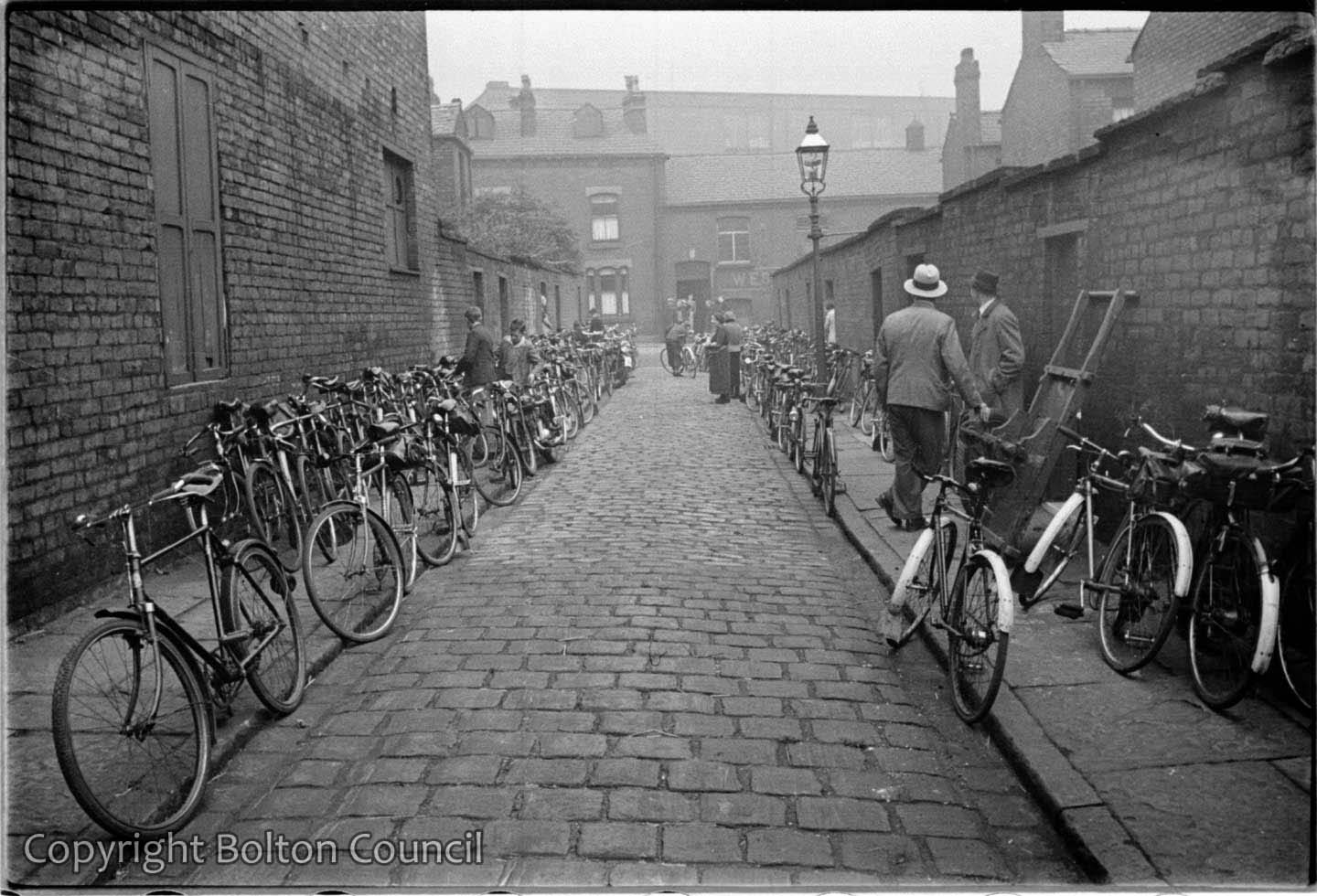
Bicycles outside the West Ward Labour Club.
From the Bolton Worktown project, a part of Mass Observation.   http://boltonworktown.co.uk/

The Construction of Documentary

In this section Price examines documentary as first defined in the 1930s, quoting Stott from 1973 on the primacy of unassailable content, content “inaccessible to critical engagement.”  (p 93) Since the camera was believed to be able to capture and reproduce reality, photographs were irrefutable proof. Price also notes in the succeeding section of this chapter that documentary photographs did not function in and of itself, but most always in support of text, to confirm what was written. Photographs were published largely anonymously.

Price covers three projects in this section, beginning with Mass Observation, an anthropological survey of British life in the 1930s, for which a number of photographers gathered images on the typical behavior of English citizens.  Their brief was to remain aloof, impartial, unobserved, to gather data without interfering with their subjects.  As one photographer is quoted about his approach to this work, “I was somebody from another planet.”  The point was to make what seemed ordinary strange in order to be able to examine underlying assumptions and identify patterns.  Unfortunately, what became of this work and of its conclusions Price does not say.  He does, however, note that much documentary work of the 30’s recorded conditions with the assumption they could be ameliorated, but never challenged the political-economic structures that bred such conditions.

Monday, February 10, 2014

Review: Wells, Photography: A Critical Introduction: Ch 2: Surveyors and Surveyed, 4th ed, 2009

Political rage against Arthur Rothstein's staged image, 1936.  More:  http://opinionator.blogs.nytimes.com/2009/10/18/the-case-of-the-inappropriate-alarm-clock-part-1/#more-11487


Documentary and Photojournalism: Issues and Definitions

Chapter author Derrick Price begins by noting that documentary has been described variously as a form, a genre, a tradition, a style, a movement and a practice.  To arrive at some understanding of something so intractable, he finds it necessary to examine the history of documentary practices, products, practitioners, and consumers.

The word documentary was first used in 1926 in relation to cinema and a particular kind of film in opposition to Hollywood fiction.  Solomon-Godeau (1991) has observed that almost all 19th century photography can be described as documentary.  While most academics concede that documentary has no defining style or technique, what sets it apart is its basis in investigation and “a goal beyond the production of a fine print.”  (Ohrn 1980)  In many cases, the photographer’s intention is not only to observe, but in doing so to bring attention that may change the conditions documented.

Wednesday, July 17, 2013

Review: War Photographer (2001): James Nachtwey

I had heard the name before but knew little about Natchtwey.  What comes to mind is Farah Nosh mentioning him at our Photojournalist workshop as one of the greatest modern documentary photographers.  I found the film online and had downloaded it some months ago before firing it up last night.  I find myself hanging out with the in-laws during the summer holiday and with some hours to spare, a great opportunity for catching up on reading, blogging, and films.

What struck me most about the film was Natchtwey himself.  He reminds me a bit of me, of someone who has spent a good deal of his life living outside his own culture and in doing so learned to modify his behavior in ways that insure his continued acceptance and survival.  He speaks slowly and articulates clearly. There is only a trace of an accent.  His words are careful and deliberate. As someone regularly in high stress situations, he has learned to manage his emotions and doesn't seem like the kind of person quick to anger, nor quick to excite.  His story of waking up one morning and deciding to be a war photographer seems mostly believable. He seems like the kind of person I would like to know.

Photographically, it was interesting to see someone working at the end of the analog age.  Most of the film seems to have been shot in the late 1990s and there are several scenes showing the photogrpaher changing film or labeling canisters.  I was surprised at how closely he gets to grieving subjects.  Just watching him made me feel uncomfortable.

I don't plan on  being a war photographer, but it was inspiring to witness someone giving his life to documenting suffering.  I'm afraid not many of us could do even half as much.

#