Showing posts with label semiotics. Show all posts

Thursday, February 20, 2014

Review: Wells, Photography: A Critical Introduction: Ch 2: Surveyors and Surveyed, 4th ed, 2009, CONTINUED

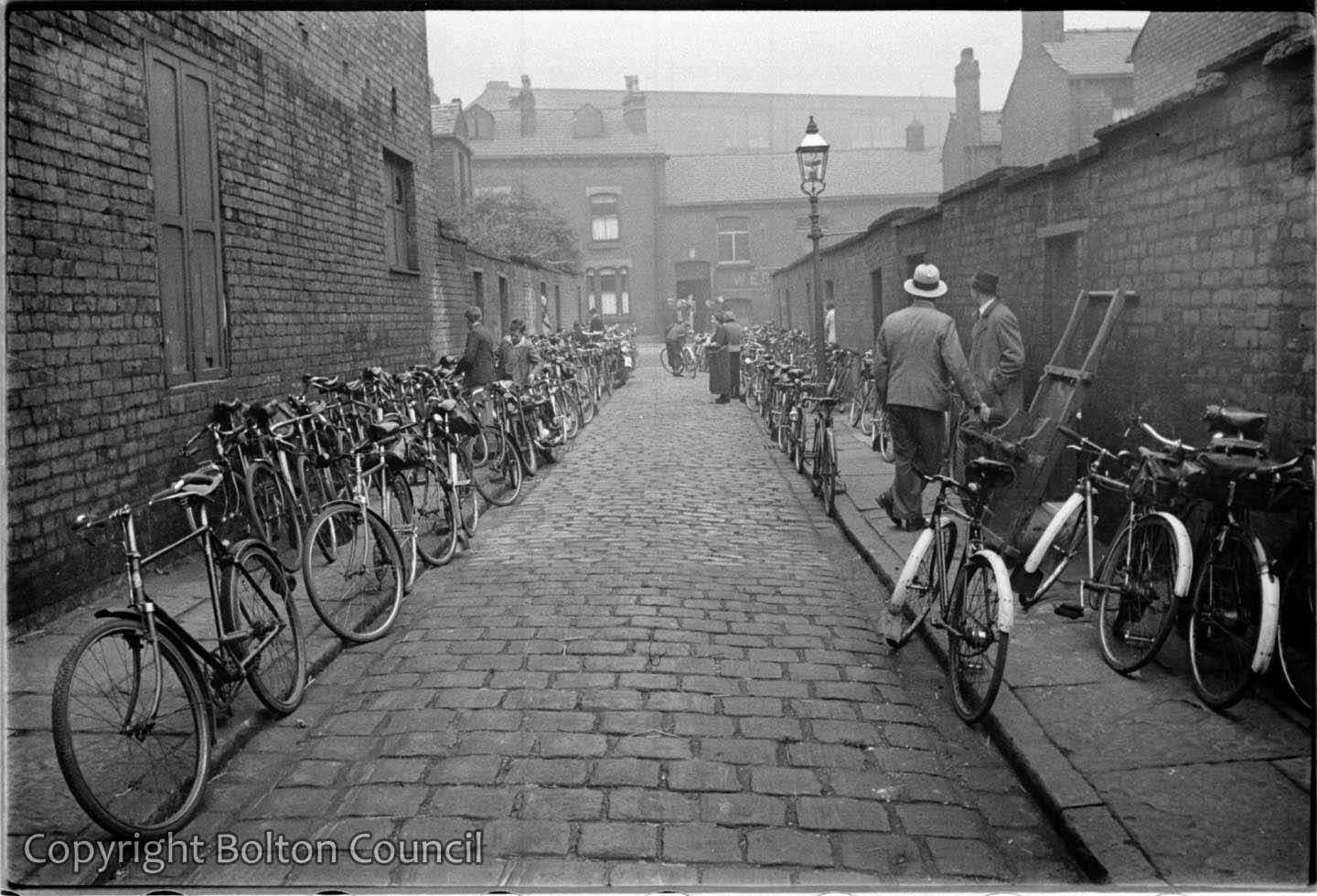
Bicycles outside the West Ward Labour Club.
From the Bolton Worktown project, a part of Mass Observation.   http://boltonworktown.co.uk/

The Construction of Documentary

In this section Price examines documentary as first defined in the 1930s, quoting Stott from 1973 on the primacy of unassailable content, content “inaccessible to critical engagement.”  (p 93) Since the camera was believed to be able to capture and reproduce reality, photographs were irrefutable proof. Price also notes in the succeeding section of this chapter that documentary photographs did not function in and of itself, but most always in support of text, to confirm what was written. Photographs were published largely anonymously.

Price covers three projects in this section, beginning with Mass Observation, an anthropological survey of British life in the 1930s, for which a number of photographers gathered images on the typical behavior of English citizens.  Their brief was to remain aloof, impartial, unobserved, to gather data without interfering with their subjects.  As one photographer is quoted about his approach to this work, “I was somebody from another planet.”  The point was to make what seemed ordinary strange in order to be able to examine underlying assumptions and identify patterns.  Unfortunately, what became of this work and of its conclusions Price does not say.  He does, however, note that much documentary work of the 30’s recorded conditions with the assumption they could be ameliorated, but never challenged the political-economic structures that bred such conditions.

Monday, February 10, 2014

Review: Wells, Photography: A Critical Introduction: Ch 2: Surveyors and Surveyed, 4th ed, 2009

Political rage against Arthur Rothstein's staged image, 1936.  More:  http://opinionator.blogs.nytimes.com/2009/10/18/the-case-of-the-inappropriate-alarm-clock-part-1/#more-11487


Documentary and Photojournalism: Issues and Definitions

Chapter author Derrick Price begins by noting that documentary has been described variously as a form, a genre, a tradition, a style, a movement and a practice.  To arrive at some understanding of something so intractable, he finds it necessary to examine the history of documentary practices, products, practitioners, and consumers.

The word documentary was first used in 1926 in relation to cinema and a particular kind of film in opposition to Hollywood fiction.  Solomon-Godeau (1991) has observed that almost all 19th century photography can be described as documentary.  While most academics concede that documentary has no defining style or technique, what sets it apart is its basis in investigation and “a goal beyond the production of a fine print.”  (Ohrn 1980)  In many cases, the photographer’s intention is not only to observe, but in doing so to bring attention that may change the conditions documented.

Sunday, October 20, 2013

Review: Wells, Photography: A Critical Introduction: Ch 1: Thinking About Photography, 4th ed, 2009 CONTINUED


Newhall's 1937 (amazon.com)
Histories of Photography

Until post-WWII, the history of photography, according to Price & Wells, was largely the history of photographic technique, though they note Gasser’s history of histories, in which three types are identified:  the priority debate (who invented photography),  manuals and handbooks of techniques, and histories of the photograph as image. Gasser feels the preponderance of the second has led to the mistaken assumption that nothing else was ever published before WWII.  

Regarding the debate on priority, the antecedents to the camera are noted, included Aristotle's notes on fixing a reflection on a wall by concentrating light through a small hole, the first notes on the camera obscura from the 16th century, and the large number of people working in optics and chemistry in the 18th century whose discoveries contributed to the publications in science journals in 1839 of details on the creation of instruments and processes for capturing light and fixing images.  The authors refer to Mary Warner Marien on the need to examine historical claims carefully, on the need for further research, particularly political, scientific, and cultural contexts. 

Two early 20th century histories are introduced as seminal in redirecting academic discussions toward more art-historical concerns, and of putting photography at the center of it’s own theory (rather than as a branch art theory).

Sunday, October 13, 2013

Review: Wells, Photography: A Critical Introduction: Ch 1: Thinking About Photography, 4th ed, 2009

Photo found at http://yimvmd.blogspot.ae/2010/09/bodyworld.html
Aesthetics and Technology

This chapter places photography within the context of wider intellectual movements, beginning with the 19th century debate about the camera as an instrument of science or of art.  The photograph came to supplant the painting in producing facsimiles of reality and from a very early date there was mass acceptance of the idea that photographs are reproductions of reality, small snippets of truth.  Individual photographers, in their style and subject, became inheritors of the attributes of Great Masters.  With the arrival of late 20th century post-modernism, all defining narratives were said to have been lost in a world grown increasingly interwoven.  Authenticity, the unique vision of the master, was no longer possible nor sought after, as was the idea that reality was somehow reproducible.  But even in an age of widespread production and consumption of digital images, the idea that photos are somehow real remains common currency.

Price & Wells note the camera’s appearance in an age of criticism where discussion often centered on how to define photography and distinguish it from other forms and practices.  They note the lack of consensus, the absence of any definable uniform practice or product, and the character of discussion:  a tendency toward reductionism - attempting to define an essence - or detailed description - avoiding any type of theory.  Perhaps one of the  more interesting ideas raised in this chapter is the camera as the product of need, rather than agent of change.  They note that technical elements were already in place in the early 19th century, and that as early as the late 18th century there are notes in the literature of ideas for capturing and processing light.  What socio-economic forces led to the invention of the camera?  One driving force was the demand for portraits, which was soon met by the new technology, putting painters - like film processors at the dawn of digital - out of work.