Showing posts with label The Photograph. Show all posts

Saturday, June 15, 2013

Review: Clarke, The Photograph, Chapter 11: The Cabinet of Infinite Curiosities, 1997

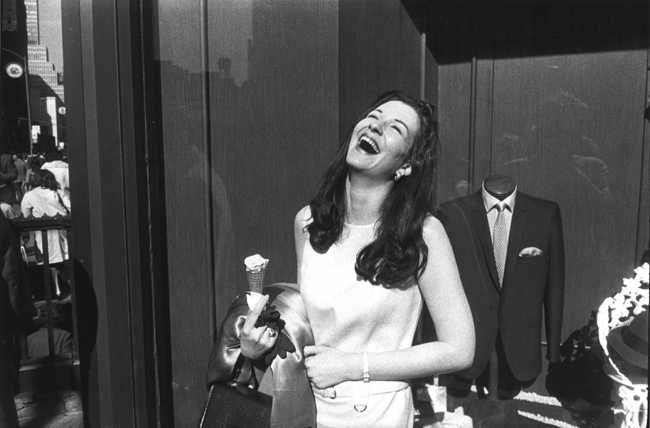
Winograd, Woman with Ice Cream Cone, 1968


Clarke's conclusion is really no conclusion at all.

“...the photograph is, in the end, open to endless meanings.”   

If you've been following along it’s really not so surprising.  He finds portraiture ambiguous, the nude contentious, documentary misleading, urban photography unclassifiable.  How could he possibly hope to finish except by asking the reader, perhaps with a wink, isn't photography mysterious, “a cabinet of infinite curiosities”?

Clarke is obviously well-read with an extensive grasp of photographic history.  He relates some interesting ideas and through his examples shows how photographs can be read.  Unfortunately he seems incapable of moderating his communication style in order to convey his ideas simply and clearly.  I can understand what he writes.  That is not my issue.  The problem is is that his writing style seems to push the reader away, rather than invite him in.  The reader is asked to deal with Clarke on his own academic terms.  How much better this book could have been if Clarke had shown some concern for his audience.

#

Saturday, June 8, 2013

Clarke, The Photograph, Chapter 10: The Photograph Manipulated, 1997

Alvin Coburn - Ezra Pound vortograph 1917
Perhaps the most notable aspect of Clarke’s review of photographic manipulation is the absence of any discussion of computer technology.  The book was published in 1997, which means Clarke was probably writing as late as 1996, a bit before the boom in digital imaging and the rise of Photoshop and other editing software.  Just as well as we get an overview of what was possible in the days before mass computing, though Clarke confines his discussion to 20th century photography, omitting such 19th century manipulation such as combination prints or differential focus.  

What comes through clearly in this survey is that photo manipulation was a practice of those who had a point to make, of photographers or artists aware of their role as producers of images.  They were ideologically, philosophically, and/or politically motivated.  Not many, it seems, manipulated photos simply because the outcome was aesthetically pleasing.  There were perhaps a few - Rejlander’s combinations prints, Coborn’s vortographs, Man Ray’s Rayograms.  But for the most part those who manipulated did so in order to create images that knowingly mocked photographic and aesthetic convention, perhaps most clearly seen in the philosophy of ostranenie, or making strange.  Among the many schools or trends Clarke surveys are constructivism, surrealism, and satire.  Techniques included unusual perspective, use of mirrors, multiple exposure, collage/montage, and the photogram.  

#

Friday, June 7, 2013

Clarke, The Photograph, Chapter 9: The Photograph as Fine Art, 1997

Having just finished Barrett’s chapter on Theory, I found much of this chapter repetitive.  Clarke takes a slightly narrower focus, largely ignoring postmodern ideas and arguments to present an overview of the Photograph as Art. He cites Stieglitz as the father of the movement to elevate the cultural value of the photograph, principally through his journals (291 and Camera Work) and his NYC gallery (located at 291 Fifth Avenue).  Clarke quotes Stieglitz’ description of the events surrounding one his better known images, The Steerage, to elaborate on how the photographer conceived his work.
Stieglitz speaks here as a formalist.  Indeed, the entire scene is described as a composition, “a picture of shapes” which bears no relationship to the scene itself.  The separate elements are reconstituted by the eye in terms of a planar geometry.  There is no interest in the particulars of the scene or the condition of the figures.  Rather, the whole is referred to an implied higher frame of reference which, ultimately, is centered in the photographer/artist;  what Stieglitz refers to as the “feeling” he “had about life.”  (p169)

Wednesday, May 22, 2013

Clarke, The Photograph, Chapter 8: Documentary Photography, 1997

Arthur Rothstein 1936 Oklahoma Fleeing a Dust Storm
Where Clarke finds portraiture ambiguous, and the nude contentious, documentary is misleading.  Linguistically it is based on a medieval word for a piece of paper providing evidence.   The ability of the camera to reproduce reality led to the idea that the camera never lies, that a photograph is a kind of evidence of past events.  Clarke uses the American FSA project to argue otherwise.  This was a government funded scheme intended to document conditions of the working poor and which fed into Roosevelt's political designs by creating public support for public works projects.  While much of the work is beautiful and produced some of Americas iconic images, it is clear the photographers, and the agency, were not out to document what they found, but to find what they hoped to document.


Monday, January 28, 2013

Clarke, The Photograph, Chapter 7: The Body in Photography, 1997

 Muybridge - Woman turning in surprise, running away

Where the portrait is ambiguous, Clarke finds the nude contentious.  This is, he says, because much of the way bodies are viewed is based on social construct.  This doesn't seem to say very much since very little of what we view or know is not understood through social construct.  His point seems to be that ideas of sexuality, identity and gender influence how nude bodies are photographically portrayed. 

Saturday, January 19, 2013

Review: Clarke, The Photograph, Chapter 6: The Portrait in Photography, 1997

Octavius Hill and Robert Adamson (Scottish, 19th century) -
James Linton, Newhaven Fisherman - 1840–50

Clarke begins his chapter on portraiture with the claim that is it “one of the most problematic areas of photographic practice, … fraught with ambiguity.”  He notes that portraiture was in its early days encoded in the 19th century practice of oil painting.  This was a highly privileged medium available to only the wealthy and was used as a means of projecting power and status.  He sees the daguerreotype as the perfect portrait medium as it required, like painting, subjects to sit for long periods (relative to photography, that is) and produced a one-of-a-kind original.  

Monday, November 19, 2012

Review: Clarke, The Photograph, Chapter 5: The City in Photography, 1997

Panorama de Constantinople Papier Salé James Robertson 1854
http://www.past-to-present.com/photos.cfm?reference=G19006


 “… there is no single traditional development by which we can map the photographic response [to the city].” 
So finishes Clarke in his chapter on “The City in Photography” after surveying the approaches of a number of photographers known for their work in what Clarke claims have been the principle loci for urban photography:  London, Paris and New York.  Basically, he’s saying that unlike landscape photography, which has demonstrated a fairly consistent outlook, there are so many approaches and views of the city that it’s difficult to classify urban photography.   

Wednesday, November 7, 2012

Review: Clarke, The Photograph, Chapter 4: Landscape in Photography, 1997


Clarke sees two major strands in the history of landscape photography, one on either side of the Atlantic.  Across both, photographers were agents of viewing, the privileged few who went out into the world and brought back images from their journeys.  

In England, they were tourists, wandering about the countryside composing the equivalent of picture postcards.  Their images were highly idealized versions of a rural utopia.  Clarke cites Roger Fenton’s work as typical of the picturesque, a genre reflecting “the leisurely assumptions of a class of people who looked upon landscape scenery in aesthetic and philosophical terms.”    That is, they didn’t live there and weren’t terribly concerned with the reality of those who did.  Their version of the English countryside was a “highly edited version … – exclusive and bound by mythology.”  Clarke doesn’t bother to explain why this might have been so.  In his introduction to the chapter he remarks on how the photograph emerged at a time when painters were interested in realism and when science was making quick advances in understanding the processes of the natural world.  Why, then, this regressive trend in landscape photography? 

Thursday, August 23, 2012

Review: Clarke, The Photograph, Chapter 3: Photography and the Nineteenth Century, 1997

Writing over Romania
I first read this chapter about a month ago but never got around to writing it up after being sidetracked by Peter Henry Emerson.   I'll write more on him later, but for now I will review Clarke's presentation of the nineteenth century, a period when some of the issues photographers and critics contend with today were first set out.

Theoretically, photography was conceived as an extension of painting and therefore subject to the same conventions in subject and presentation.  This was exemplified by composite photographers such as Robinson and Rejlander, whose classical subject matter sought to convey ethical or moral intent, to "instruct, purify and enoble."1   At the same time, photographers were enthralled with science and engineering.  The world seemed a place where discovering the laws of nature made possible rapid social and economic development, where the real could be uncovered.  And what better example of capturing reality than the new invention of the camera, a machine capable of reproducing the seen, and reproducing it in detail never before possible with the brush.  


Wednesday, July 4, 2012

Review: Clarke, The Photograph, Chapter 2: How Do We Read a Photograph, 1997

In How Do We Read a Photograph Clarke claims that we don't just look at photographs, we read them.  He introduces French literary critic Roland Barthes, who in the early 80’s published what has become an iconic text in photography studies, Camera Lucida.  Barthes argues for a two-layered conception of the reading process, one that begins with what he calls the studium, our first impression of the image.  This might be more akin to looking, to acquiring a general impression.  Should we take time to linger, we may notice a small detail, something that draws us into the photo, something that when followed leads to exploration and new discoveries.  This Barthes calls the punctum - the puncture, the hole down which we fall into the image.  I’ve had this experience for perhaps as long as I have read photos, but I never conceptualized it, never named it.  It happened to me most recently when reading one of the images in this chapter, Arbus’ Identical Twins.  What drew me in were the eyes.  One set heavy, the other wide.  And from there I began to notice other differences that suggested these twins were not so identical.

Thursday, June 14, 2012

Review: Clarke, The Photograph, 1997


At the OCA forums, more than a few students complained about the academic density of this text.  Even some of the reviews at Amazon complained about the opacity of the language.   I was expecting the worst.  But having just finished the first chapter I can say that the reviewers are right – and wrong.