When I started off I intended to write a single review of the five Atget books I owned or borrowed. I wrote and posted about each separately and now don't have much left in me to write a separate review covering all five. Fortunately, I do have a few photos, and so can summarize in image rather than word.
Open College of the Arts | The Art of Photography [2012-2013] | Digital Photographic Practice [2013-2014] | People and Place [2014-2015]
Showing posts with label Atget. Show all posts
Tuesday, April 22, 2014
Book Review: Five Atgets
When I started off I intended to write a single review of the five Atget books I owned or borrowed. I wrote and posted about each separately and now don't have much left in me to write a separate review covering all five. Fortunately, I do have a few photos, and so can summarize in image rather than word.
Thursday, April 17, 2014
Book review: Atget Paris. Gingko Press, Corte Madera, CA, 1992.
There’s not a lot in this book but photos, but there are more of them than in any currently in-print collection, over 800 by the publisher’s count. The book is like a large brick and is not something you’d like carry around for casual viewing.
The photo selection emphasizes Atget's urban cityscapes, organized geographically by arrondissement, Paris’ wards or districts. There is less emphasis on architectural features (such as grillwork or door knockers) and interiors, though examples of the tradesmen, the city outskirts, and transport have been included. After looking at so many books organized largely around themes, which also represent a chronological progression as they were often shot as a set, its startling to see examples of these images side by side representing place. Even if you've seen many of Atget's photos before, seeing them organized thus can open up new understandings of his work.
Tuesday, April 15, 2014
Book Review: Adam, Hans Christian ed. Paris: Eugene Atget. Taschen, Koln, 2008 edition.
In terms of number and size of images relative to cost, this is perhaps the best collection of Atget’s work currently available. It contains 204 images, most featured on a single page, though there a few instances of two or even 4 images to a page The first 14 pages are full-size images, within only a 2cm border. Other pages have a wider bottom border to accommodate captions.
The book features an essay by Andreas Krase in English, French, German (more on that in a moment) as well as
- a map of Atget’s Paris
- the only three known portraits of Atget
- photos of his business cards
- photos of covers of Atget’s handmade portfolios
- a biographical timeline
- an abbreviated bibliography
- a glossary of relevant French vocabulary
Wednesday, April 2, 2014
Book review: Badger, Gary. Atget 55. London: Phadon Press, 2001.
Badger’s 13-page introduction is framed as The Atget Problem: what exactly does his photography represent? The ex-thespian described himself as a creator of documents, but has since been hailed as a founding father of modern photography. Because he had so little to say, he left behind much to discuss. Badger sees the Atget Problem as a mirror of the problem of photography: what exactly is documentary photography?
Badgers believes much of Atget’s work is slightly off-key, eccentric, particularly in relation to his competitors. His use of a wide angle lens sometimes distorted verticals and he wasn’t concerned about extraneous elements in his images. He didn’t photograph the upper classes, nor much of the lower. He worked in environments decidedly middle class to which he had easy access.
Sunday, March 30, 2014
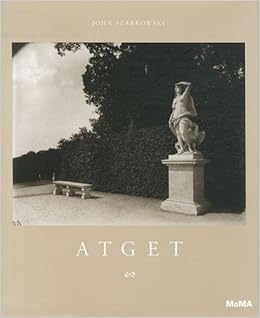
Book review: Szarkowski, John. Atget. NY: The Museum of Modern Art, 2000.
Sunday, February 23, 2014
Film Review: Eugène & Berenice; Michael House, director; 2008
| Eugene Atget and Berenice Abbott |
Looking for a film on Atget, I was fortunate to learn about Berenice Abbott, a young American who made her way to Paris in the 1920s and fell in with Man Ray as an assistant. Man Ray was a neighbor and admirer of Atget, and through her employer Abbott made contact with the city's photographic chronicler, making the only known portraits of Atget just days before his death.
Abbott returned to US just before the Wall Street crash of 1929 and inspired by Atget began work on her own archive of the depression-era NY of the 1930's. She also managed to purchase what was left of Atget's image collection (that wasn't owned by the French government), arranged for a volume of photos to be published in the US and France, and wrote and published her own book on Atget in the 1960s. She sold her collection to it's current owner, The Metropolitan Museum of Art.
I was unaware that Atget had done a study of prostitutes and wonder if I might find the confidence to do the same. It would make a wonderful study for Dubai. I have at least a couple of massage parlors in my neighborhood. Do I have the courage to ask?
Abbott returned to US just before the Wall Street crash of 1929 and inspired by Atget began work on her own archive of the depression-era NY of the 1930's. She also managed to purchase what was left of Atget's image collection (that wasn't owned by the French government), arranged for a volume of photos to be published in the US and France, and wrote and published her own book on Atget in the 1960s. She sold her collection to it's current owner, The Metropolitan Museum of Art.
I was unaware that Atget had done a study of prostitutes and wonder if I might find the confidence to do the same. It would make a wonderful study for Dubai. I have at least a couple of massage parlors in my neighborhood. Do I have the courage to ask?
Sit Up Straight Production
Michael House, director
2008
52 minutes
52 minutes
| Atget's Paris, Abbott's NY # |
Subscribe to:
Posts (Atom)